
6,477 new homes for Banbury. Lovely. Now, about the roads, schools and pipes…
The forecast promised warmth and sunshine.
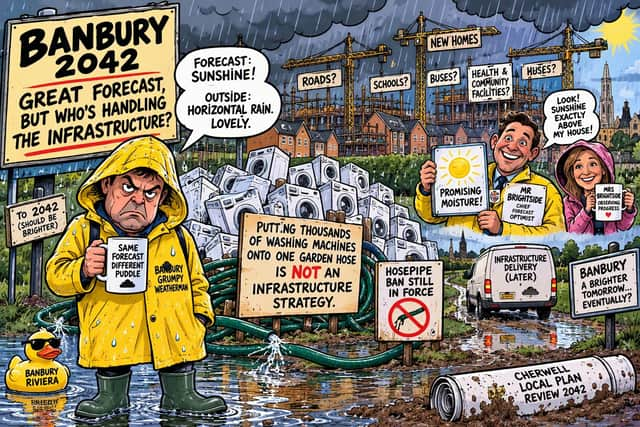

Banbury looked at the forecast, considered it carefully, and selected horizontal rain.
Lovely.
Apparently, summer is arriving just in time for the hosepipe ban to be lifted around Christmas.
Last year’s restriction survived until 27 November. As of 12 October this year, the 2026 Temporary Use Ban was still in force.
Recent rain is welcome, apparently, but sustained rainfall is still needed before the restriction can be lifted.
At this rate, the hosepipe ban may qualify for winter fuel support.
I have a colleague called Richard.
Richard is one of those people who can find the positive in almost anything.
You could show him a weather map consisting entirely of warning symbols and he would probably point to a tiny gap between two clouds and say:
“That looks promising.”
This is why, around here, Richard is Mr Brightside.
Horizontal rain?
“Promising moisture.”
Forty-mile-an-hour winds?
“Good drying weather.”
I fully expect him to produce a laminated diagram showing sunshine directly above his house while the rest of Banbury floats past on a wheelie bin.
Mrs Brightside has now joined the platform as well.
I still don’t know what Richard has done wrong.
Richard, naturally, remains delighted.
This makes him extremely difficult to warn.
And strangely enough, that is roughly how I felt while reading the submitted Cherwell Local Plan Review 2042, which is currently going through independent examination.
The forecast is absolutely glorious.
The plan gives a housing delivery figure for Banbury of 6,477 homes across the period from 2020 to 2042.
The vision also talks about improved public transport, cleaner air, reduced congestion, new facilities, more accessible open space and a thriving town centre.
Sounds wonderful, doesn’t it?
Personally, I support more homes.
I support investment.
I support better buses.
I would also like Banbury to remain somewhere my daughter has a chance of affording to live one day without first discovering a goldmine beneath Spiceball Park.
But homes are not merely numbers in a document.
They are kitchens, cars, school runs, GP appointments, drains, deliveries, bins and morning commutes.
Putting thousands of washing machines onto one garden hose is not an infrastructure strategy.
Particularly when we have been told not to use the hose.
It is a plumbing incident with an executive summary.
And that leaves me with one question.
Are the roads, schools and services coming with the homes, or following behind in a later van?
SMALL GEARS BEFORE THE BIG MACHINE
A Local Plan has to look ahead.
It deals with needs, sites, infrastructure and decisions stretching years into the future.
And there is one phrase in this one that caught my attention.
The plan describes its overarching priority for Banbury as the “aligned delivery of housing and infrastructure”.
“Aligned” is doing some fairly heavy lifting there.
Because if the housing and infrastructure are aligned, they should presumably be travelling in the same direction.
The question is whether they are travelling to the same timetable.
What comes first?
What is connected to a particular stage of development?
Who is responsible for each part?
How will it be funded?
And how will residents know whether the housing and infrastructure are still travelling in the same van?
Because “later” can be a surprisingly elastic date.
Infrastructure is hardly the decorative ribbon on a development.
It is what makes the whole thing work.
It is classrooms, health and community facilities, buses, roads and all the other deeply unglamorous things that rarely make the front of the brochure.
It is safe walking and cycling routes that actually take people somewhere useful, rather than ending mysteriously beside a roundabout.
It is the difference between looking at Banbury as one connected town and looking at it as a collection of planning applications that have never been formally introduced.
A VISION AND A TIMETABLE
There is plenty in the plan’s vision that I like.
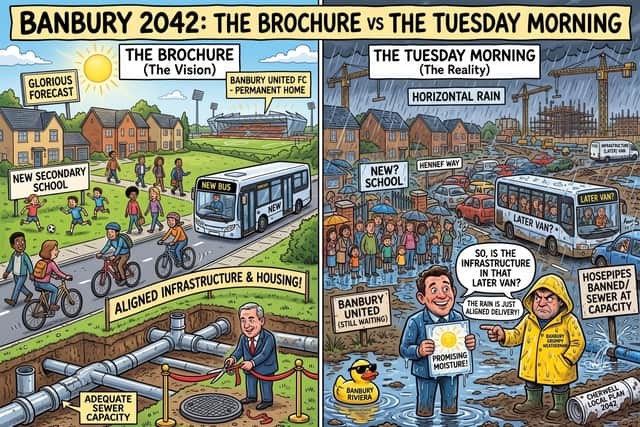
It includes strategic transport improvements, reduced congestion and pollution, better public transport, Canalside regeneration, improved community and health facilities and a new secondary school.
It also includes securing a permanent home for Banbury United Football Club.
Those are not small ambitions.
They could make Banbury a better place to live, work and raise a family.
That is the vision.
Then comes delivery.
Not everything can arrive before the first house is occupied. That much seems obvious.
But the document itself puts housing and infrastructure together.
So I find myself following the connection.
When does each part enter the picture?
Which pieces are tied to which stages?
Which depend on later decisions, funding or development?
And what does “aligned delivery” look like when it leaves the document and meets the actual town?
That is when my mind goes back to the sinks, toilets and washing machines.
And the pipes underneath them.
Not the pipes in the artist’s impression.
The real ones underground.
The unglamorous ones.
The ones that never appear beside smiling cyclists and suspiciously well-behaved trees.
Nobody stands beside a new drain for the brochure photograph.
Nobody cuts a ribbon and says:
“Ladies and gentlemen, behold the adequate sewer capacity.”
But that is the strange thing about infrastructure.
Much of the important stuff is precisely the stuff you only notice when it isn’t working.
BANBURY IS AN ENGINE-ROOM TOWN
Banbury is a working town.
It isn’t a showroom town.
It is an engine-room town.
People make things here. They move goods, run businesses, staff the hospital, teach children, serve customers and keep the wider area functioning.
Personally, I would like growth to strengthen that.
I would like it to bring investment, opportunity and better connections.
And I would like Banbury to remain somewhere our children can build lives of their own.
That is my view.
The Local Plan gives us a picture of Banbury in 2042.
It is greener, healthier and better connected.
Public transport has improved.
Congestion and air pollution have fallen.
New services and facilities have arrived alongside the homes.
I genuinely hope that forecast is right.
I would quite like to look back in 2042 and discover that all my grumbling was unnecessary.
Richard will already have prepared the laminated certificate.
Probably framed.
Mrs Brightside will presumably still be gathering evidence.
And I will finally have to concede that Mr Brightside was right all along.
Which, frankly, may be the least realistic prediction in the entire document.
But optimism and scrutiny can occupy the same page.
Supporting new homes does not stop me looking carefully at the accompanying promises.
And asking how something will be delivered does not automatically mean opposing it.
The document puts housing and infrastructure together.
I am simply following the connection.
Because these are not only housing numbers.
They eventually become thousands of ordinary mornings.
Kettles.
Showers.
School runs.
Buses.
Appointments.
Deliveries.
People leaving for work.
People coming home.
People simply trying to get across Banbury at half past eight without accidentally ageing several years on Hennef Way.
That is when a planning document stops being a planning document.
It becomes somebody’s Tuesday.
And if the forecast says the homes and infrastructure are aligned, I am left with the same question I had at the beginning:
Are they actually arriving in the same van?
The Banbury Grumpy Weatherman
GRUMPY FOOTNOTE
(This is my personal reading of the published Local Plan as a Banbury resident, not a technical assessment. I have followed the connections the document makes between homes, infrastructure and services. The opinions are mine. Planning professionals may read some of the detail differently.They usually have larger documents and considerably fewer garden-hose metaphors.)