
The fascinating history behind a special thatching job by two Banbury craftsmen
Behind the thatching of an ancient building, carried out by two Banbury master thatchers, lies a fascinating story.
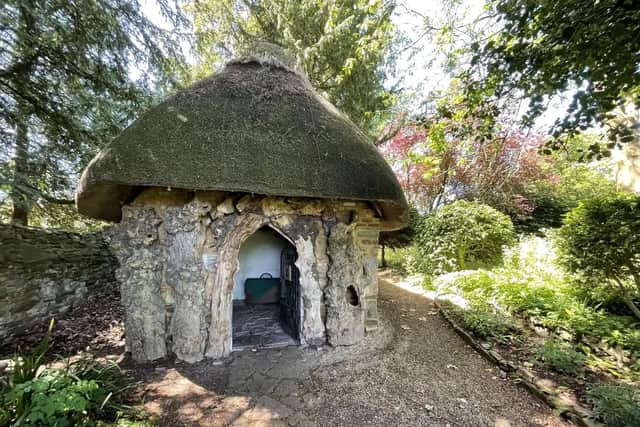
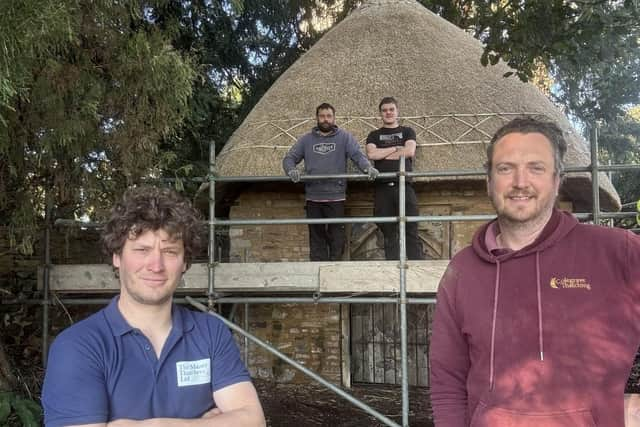
Michael Stanley and Miles Colegrave spent a week re-roofing the small, stone-built room in the garden of an 18th century doctor, Dr Edward Jenner – the founder of modern vaccines. See report gallery here.
The dedicated man discovered vaccination after realising that milkmaids who caught Cowpox from the animals they worked with, were immune to Smallpox – a scourge of the times.
He published his findings in 1796 and his discovery changed the world, saving countless lives through the centuries. Prior to this, a process called ‘variolation’ had been used since the 13th century, where individuals were deliberately infected with Smallpox from scabs or pustules to create a mild case of the disease, providing immunity.

Madisson McKone, visitor experience and learning manager at The Jenner House and Museum in Berkeley, Gloucestershire, said: “He created the vaccine using Cowpox – which affected cows and the milkmaids who milked them.
"It was common folklore that if you had Cowpox, you couldn’t get Smallpox which was an ancient and very disfiguring disease.
"Jenner took the knowledge of country people and systemised it. He used scabs to give them a localised Cowpox infection and then tested them with Smallpox.
"He tested his own children first and his gardener’s son James Phipps, who was about eight. That first scientific paper still exists, though it was initially rejected for not being robust enough in terms of numbers, and was seen more as ‘country knowledge’.
"The next Cowpox outbreak was a couple of years later and Dr Jenner started innoculated people using threads of prepared ‘vaccine’. He realised the more people innoculated the better. “He decided his knowledge was so important he self-published his work and it spread through the medical profession at home and internationally.”
Fear of Smallpox was huge. This was all before ‘germ theory’ and it was eventually Louis Pasteur who recommended the name ‘vaccine’ (after vacca – Latin for cows). "Dr Jenner’s vaccines sparked a big backlash from those, particularly in London, who were profiting from their own Smallpox ‘cures’. Also the Church thought it unholy to be using animal products on humans.
“However in 1853 when vaccination was seen to be saving lives and was an effective intervention in Smallpox, it was more systematised and here in Britain, compulsory vaccination was made mandatory by law for all children unless there was a good reason. Again there was a backlash by by parents and some opponents.”
Dr Edward Jenner was a student of Dr John Hunter, a pioneering Scottish surgeon, anatomist and ‘father of scientific surgery’ who became a lifelong friend and mentor.
Away from medicine, Dr Jenner was a musician and a naturalist – he could name any bird from its call, understood hibernation and also discovered the cuckoo syndrome. It was first thought that the cuckoo would hijack the nest but Jenner found that it was the cuckoo chick that threw out the eggs of the host bird’s nest. Jenner was involved in development of hot air ballooning and passionate about understanding science and the world.
- The Temple was on Historic England’s heritage ‘at risk’ register. Renovation costs were provided by the National Lottery Heritage Fund.