
Calls for action as Oxfordshire drought sparks algae warnings, wildfires and water restrictions
After a week of drought, Oxfordshire is feeling the impact of this year’s repeated heatwaves with “almost fluorescent” green rivers, blackened fields and hosepipe bans
On July 29, the Environment Agency (EA) declared the county to be in drought – its most recent report lists potential impacts as including “deteriorating water quality”, “increased field fire risk during harvesting”, and “growing restrictions on water abstraction”.
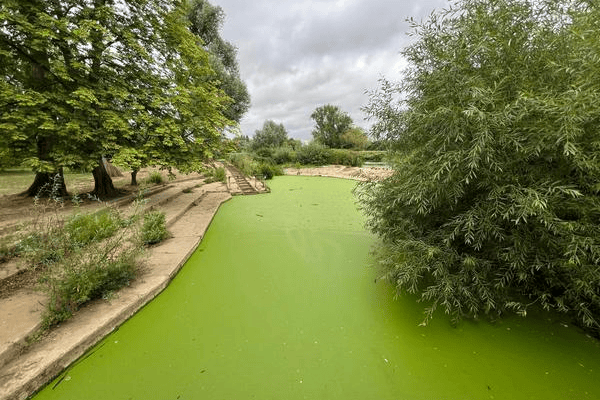

In its first week of official drought, after the hottest July on record, rain-starved Oxfordshire has already seen these predictions realised.
The likelihood of sudden change to the circumstances is tempered by the EA report.
It said: “Although a cooler and more unsettled weather pattern is forecast in the coming days, rainfall totals are expected to remain relatively low and are unlikely to significantly improve the overall water resources situation.”
One of the visible manifestations of this has been a “thick mat” of weed over a historic swimming spot.
On Wednesday, August 5, pallid, yellowing grass lined a bright green River Cherwell, by what was a nude bathing area in the University Parks for around 400 years, known as Parson’s Pleasure.
Signs from the university dotted the riverbank, carrying warnings that the algal bloom is caused by “the recent dry weather conditions” and that it “may be harmful to humans and pets”.
The university spokesperson has since said the parks team put up the signs “as a precaution to avoid any risk to local people and/or their pets”.
They explained that, having “investigated the matter more closely”, the team believes the “thick mat resembling an algal bloom” is “duckweed,” which it said had been caused by “low water levels, warm conditions, plentiful sunlight and slow river flow”.
They said: “There is therefore no risk to people or animals from poisonous algae – although the very low water levels and poor visibility means entering the water is still a bad idea.”
Before this assertion, one resident, Angela Mills Wade, had taken to social media warning others to heed the warnings.
She said: “Insane amounts of algae today, which is almost fluorescent!”
Elsewhere in the county, the Environment Agency (EA) has confirmed blue-green algal blooms.
This includes Hardwick Parks, a holiday park, which has shut its lake and been told to “restrict access” to it by the EA.
Sheriff of Oxford, Linda Smith, called the situation on the city’s waterways an “outrage,” saying “visitors to Oxford should be able to enjoy a punting trip without fear of becoming ill”.
She has been campaigning for improvement to the water quality at Port Meadow, a city council-designated bathing spot which has consistently had “poor water quality because of bacteria most probably from human faeces”.
Ms Smith said: “Residents are also observing the signs of a polluted river elsewhere in the city and there are fears about the impact on wildlife as well as human health.”
She supports collaboration on improvement to the county’s rivers but says “we must not stop demanding tighter regulation of the water companies and the need for more investment in the infrastructure necessary to keep our rivers clean.”
County council Green group leader and Cherwell councillor, Ian Middleton, said: “Algal blooms are a visible warning of the growing pressure that climate change is placing on local water systems.
“When water levels drop and temperatures rise, pollutants and nutrients become more concentrated, oxygen levels fall, and freshwater habitats come under severe stress.”
He warned people to “avoid contact” with the water to “keep children and animals away” and to report “suspected blooms” to the EA, while calling for action.
Mr Middleton said: “This summer’s unprecedented hot, dry conditions have underlined the urgency of action on climate change and community protections, all issues that Green councillors have been leading on over the last several years, including our recent motion calling for resilience planning against the impacts of climate change.”
He wants to see “local responses” including a reduction in “pollution from agriculture, management of wastewater and urban runoff, the restoration of wetlands and natural flood management, increased tree planting, improved drought planning, investment in water efficiency and the acceleration of measures to reduce greenhouse gas emissions”.
He has also called for a “reassessment” of major development impacts amid “increasing water scarcity”.
The founder of an Oxfordshire waterways campaign group, Windrush Against Sewage Pollution (WASP), Ash Smith said: “The drought always means a disaster for our waterways.”
He warned of the impact of water companies “failing to manage the water supply, leaking billions of litres every year”.
Ash said: “This means that the sewage that they are pumping in is less diluted, more nutrients per litre, causing algal blooms which cause immense damage and in the most extreme circumstances, risk public health with blue-green algae and of course that affects dogs as well, seriously, often fatally.”
He added that this is why the WASP is arguing for public ownership of water.
A Thames Water spokesperson said: “There are no sewage treatment works or discharge points within 5km of University Parks in central Oxford. “
The spokesperson added that the company is making “continued improvement in tackling leakage” with “modernising our infrastructure, and using innovative technologies to identify and fix leaks”.
Restricted access to algae-filled water is one of several drought measures which are now in place, including the hosepipe ban affecting around 10 million customers under Thames Water – last summer’s ban lasted until November, and the company has not revealed when this year’s is likely to end.
Use of locks has been restricted by the EA to “conserve water” – this was originally impacting St John’s Lock in Gloucestershire to Osney Lock in Oxford and was recently extended to include Goring Lock to Culham Lock and from Penton Hook Lock to Shepperton Lock.
Around all Thames locks, benches have been covered with tape for “the safety of the general public and [EA] staff”.
The agency said: “In periods of prolonged dry weather, trees can shed branches with little warning, in what is known as sudden limb drop.
“We are considering how best to keep these areas safe, and may require some benches to be relocated so they are not under overhanging trees.”
Blazes in Oxfordshire fields have seen fire and rescue crews rushing to farms and a school to tackle flames, leaving burnt land in their wake.
Oxford East MP Anneliese Dodds said: “This spring and summer’s sustained, record-breaking hot temperatures have only underlined how the climate crisis is already affecting us here in the UK.
“Our brave firefighters and other emergency workers have been at the sharp end of trying to protect people from the very worst impact.”
Ms Dodds says she will “continue to push for action both here in the U.K. and internationally, so that we can prevent this crisis from getting even worse” and described how “the green transition” will enable “economic benefits”.
Asked about preparedness for wildfires amid a reduction in full-time equivalent on-call firefighters, an Oxfordshire Fire and Rescue spokesperson said: “We have crews and resources in place to provide emergency response across Oxfordshire”.
Its crews have recently supported other services with addressing wildfire blazes across county boundaries, while also rushing to the scenes of several field and flat fires in Oxfordshire in recent weeks.
As the drought continues, the fire service says not to light bonfires or open fires, to “only use BBQs in designated areas”, to take litter home – noting glass can “ignite dry grass”, and “avoid any activity that could create a spark or flame in the countryside”.