
Trees and hedges around Banburyshire take on ghostly appearance as they are infested by caterpillars
Some trees and hedges around Banburyshire are taking on a ghostly appearance as they are infested by caterpillars.
Our video was taken by Banbury Guardian reader Nicky King who found three trees on a roadside verge becoming veiled in webbing, believed to be woven by one of the family of Ermine moth caterpillars.
The webs, which can look like Halloween installations, are striking and the creatures inside can look off-putting but they are harmless. It is a common sight to see at this time of year; Ermine moths’ metamorphosis is at a critical growth stage in May and June.
Mark Parsons Head of Moth Conservation with Butterfly Conservation said: “At this time of year we often receive reports of ghostly silken webbing covering sections of hedgerows and, on occasions, individual trees. Although it can look rather sinister, don't be alarmed. The most likely culprit is a harmless caterpillar.
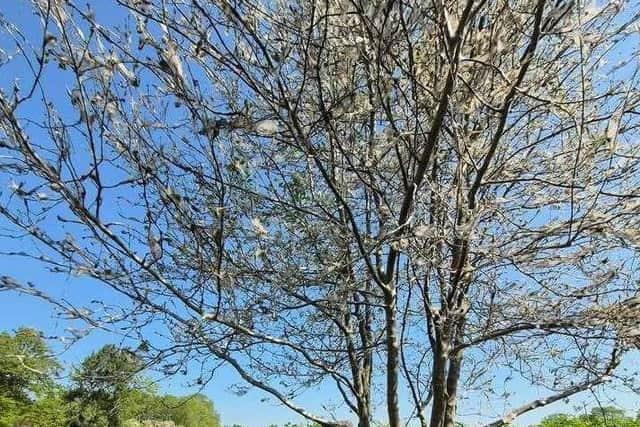

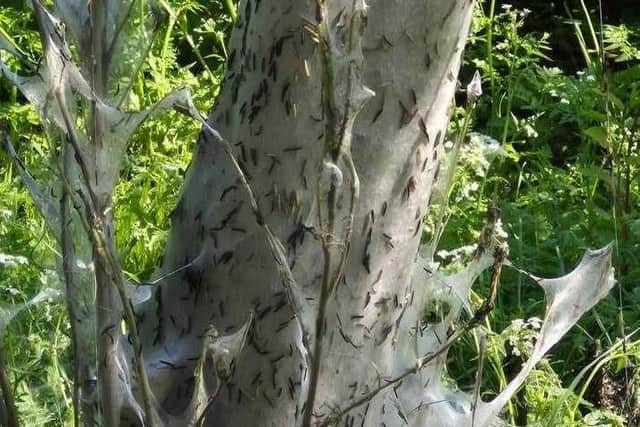
“These striking and obvious webs hide hundreds and sometimes tens of thousands of caterpillars of a group of moths called the Small Ermine moths.
"There are eight species in this group, although only the Orchard Ermine Yponomeuta padella, Spindle Ermine Y. cagnagella and Bird-cherry Ermine Y. evonymella tend to produce such extensive webbing, the former mainly on blackthorn and hawthorn, the others on spindle and bird-cherry respectively.
“The Bird-cherry Ermine tends to have a more northern distribution compared to the other two and occasionally whole trees can be covered by their webs, the leaves stripped bare giving the tree an eerie appearance. Sometimes these webs are so extensive that they can cover nearby objects such as benches, bicycles and gravestones.” Why do these species spin these webs and live together in such large numbers? It's a successful evolutionary strategy, providing protection from predators through safety in numbers. However, numbers are hard to hide and hence the production of the silken webbing.
These webs and caterpillars are harmless and usually last from May to June. The webs slowly disappear over the summer and typically the hedgerow shrubs/trees recover. The adult moths fly later in summer and all look superficially similar, being white or greyish with many small black dots, hence the ermine name. Ermine moth webs should not be confused with other web-forming larvae, which can be found around the same time, although these nests tend not to be so extensive and the caterpillars of most are hairy.
Nests could belong to the nationally scarce Small Eggar Eriogaster lanestris, whose webs can reach the size of a small football; the declining Lackey Malacosoma neustria, with their striking stripy caterpillars; the Brown-tail Euproctis chrysorrhoea, which is expanding its range; and the introduced Oak Processionary Thaumetopoea processionea.
"The caterpillars of the latter two have urticating hairs, i.e. these can cause rashes, and because of this we advise that all hairy caterpillars and webs should be avoided and not handled,” said Mr Parsons.
Other readers have reported patches of hedging in the Broughton and North Newington area covered in the distinctive webbing. Many hope the emerging moths will help the preservation of bats which are the primary predator of moths.