
'The state of rural roads is beyond a joke', says Banbury area woman whose carers are suffering
'The state of rural roads is beyond a joke', says Banbury area woman whose carers are losing pay to fund puncture repairs.
Jan Guice of Chacombe said one carer was stranded at her house for hours waiting for a repair, leaving scheduled patients without support.
The following day a district nurse suffered a puncture in a pothole and could not reach her to administer her medication.
"Three weeks ago my husband was on a journey where the ambulance was swerving to avoid craters on the road to Banbury,” she said.
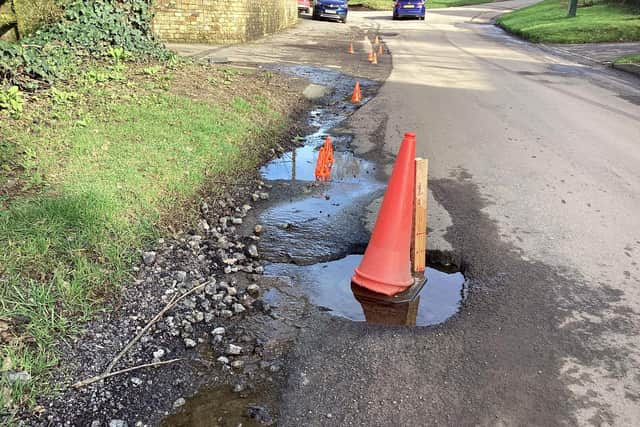

"These carers who visit the homes of people in need cannot claim on their insurance for their time. And none can afford to lose over a day’s pay on repairs.
"Last week the carers visiting my house (four times a day) lost a tyre and told me it was their fourth tyre this month. They were stranded at my house for hours, leaving vulnerable people who were expecting to be helped to bed without their support.
"The following day the district nurse lost a tyre on the way out of the village causing her to be unable to complete scheduled visits. In my case it was to give insulin.
"I checked up on the West Northants claims website and it boasts that people's claims normally fail. It’s our health workers visiting homes who are picking up the cost of shoddy road repairs. Essential workers should be reimbursed for their puncture repairs without a question.
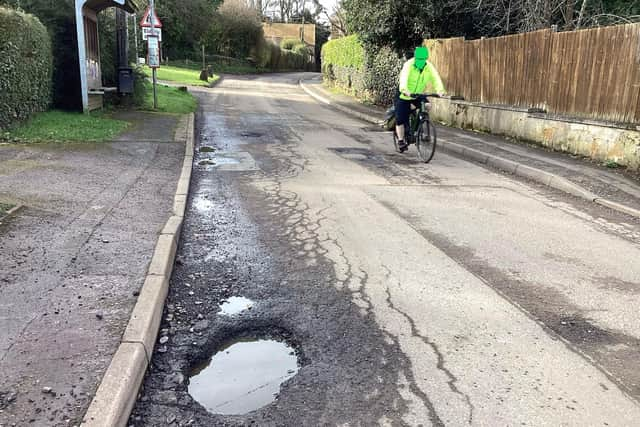
"Putting at risk vulnerable people whose health visitor cannot arrive at the prescribed time demonstrates a flaw in the Highways Inspection Policies for Rural Areas.”
The West Northants Council website claims page says: “Although unfortunately incidents do occur, very few are actually attributable to the negligence of the Council. The majority of the claims brought against the council are successfully defended.”
In a letter sent to the Banbury Guardian Mrs Guice said Chacombe, with staff and visitors having no alternative but to drive to its 77-room residential nursing home, plus industrial farm buildings and active farms, needs its roads to be robust.
Like many villages in Banburyshire Chacombe has no village shop and residents have no alternative but to drive to town for provisions.
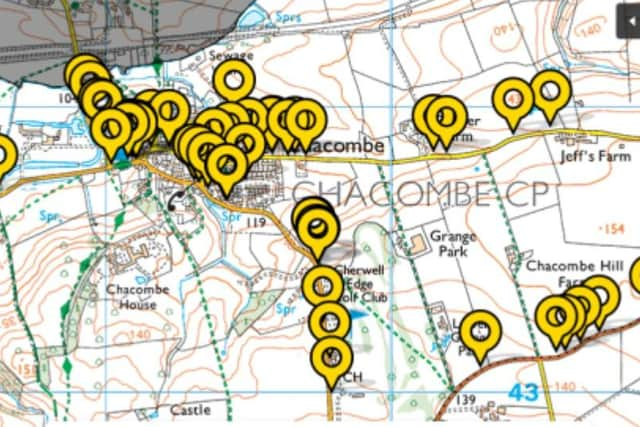
"I have lived here a year and seen at first hand potholes that are bad repair jobs and crumbling roads due to the heavy machinery using the roads to access the fields and businesses around the village,” said Mrs Guice.
“Roads that are given low priority over trunk roads are now giving up completely. The ‘quick patch and run’ procedure is not working. The only businesses thriving at the moment are the garages supplying tyres and fixing springs.”
Mrs Guice said: “The council seems to have unseen rules as to whether a claim is valid. The following seem to be the type of excuse for non payment: the council does not know it exists; the road was inspected in the last six months and it was deemed OK; the council does know the pothole exists but has not investigated or marked it up for repair; the hole is not deep enough when the council last inspected it so it’s not their fault and there is not enough council-approved evidence of the hole.”
She suggests a change in the system so that a clear photo of a pothole on Fix My Street, showing depth and size, with any sharp edges visible, should be accepted as proof. Those taking photos should take a clearly marked stick to show the depth of the pothole, she said.
"Whether or not the council views it personally… it is known and from that moment the council is liable. Maybe then the council will revert its attention to properly repairing whole stretches of road rather than use the ‘spot a mole, whack it’ approach,” she said.
A WNC spokesman did not address Mrs Guice’s concerns about health services staff reaching patients safely. However he directed readers to a page detailing the council’s priorities, which lie with major roads.
Cllr Richard Butler, Cabinet Member for Highways and Transport said: "Recent wet and freezing weather has caused rapid deterioration across the road network, so we’re prioritising the most urgent, safety‑critical repairs. “In some areas, our crews are carrying out temporary emergency patches to make locations safe quickly, and they’ll return to complete more permanent repairs as soon as conditions allow. “Some of these issues occur very quickly and we’re asking everyone to report any they’re aware of. Please don’t assume we already know about them.”
The Highways web page says: “At a time when the network is experiencing such high levels of strain, public reporting is vital. This can be done via the West Northamptonshire Council app, our website, or Fix My Street and helps us spot newly emerging issues quickly, assess the severity and prioritise repairs based on safety.
"The rate of new defects emerging across the network is outpacing our ability to respond in the usual way. Our highways teams are having to make difficult but necessary decisions about where they focus their efforts - balancing immediate safety risks with what is realistically achievable in the short term.
“We cannot be everywhere at once, but with continued support from residents, we can ensure that the most urgent issues are addressed as swiftly as possible. Every report helps us keep the network safe and ensures our teams are deployed where they are needed most.”