
New video - Network of underground tunnels discovered beneath Banburyshire village
The secrets behind a network of underground tunnels discovered beneath Bloxham are being investigated by a new group.
Residents have heard tales about tunnels over the years, and some have documented fragments of evidence but few have been explored – until now.
Back in September, 2024, Bloxham’s Facebook page saw a lively discussion develop about the existence of tunnels and the group was formed in a bid to find our more about this fascinating chapter of the village’s history.
David Green, one of the founder members of Bloxham Underground Tunnel Society, said: “A few of the comments were thought not be accurate, so we decided to investigate some of the myths and the published articles involving the tunnels.
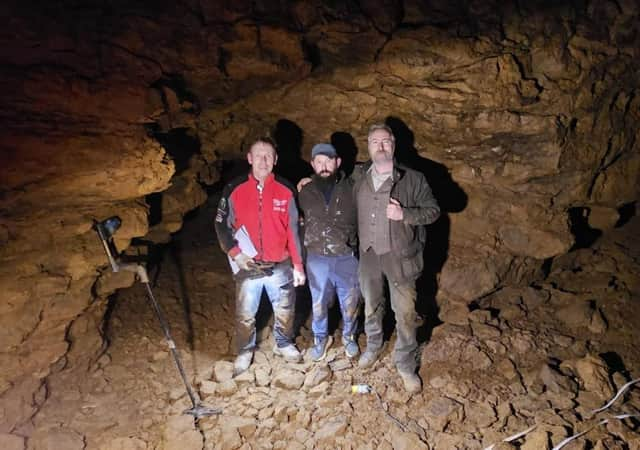

“There are thousands of underground tunnels and passages in Britain that historians still cannot explain. People are going about their daily lives are walking the streets and countryside and driving on roads without realising what lies beneath. We are slowly uncovering Bloxham's secret past – and there is still lots to do.”
The tunnel group gave its first presentation on its findings at a meeting held by Bloxham History Club at St Mary's Church. Some 300 people packed the venue making it the club’s most highly attended event.
Members of the tunnel group are Mr Green, chairman, Martyn Wyatt, Tom Smith, Simon Finch, Martin Whitton and Jim Smithson, all offering different skill sets to give the society the best chance of a fruitful investigation.
“We had a list of locations of possible entrances to the tunnels,” said Mr Green. “We arranged several meetings and invited Professor Colin Eddie who is one of the country’s leading tunnel experts, Dr Henry Pairaudeaua – a specialist in tunnel engineering and design - and Oli Phillis, President of Birmingham University Caving Club and some of his team.

“Last August we met up with the Birmingham University cavers and went into our first tunnel in the garden of an old Grade 2 listed house in the village. We opened the tunnel door and the cavers with their equipment were the first to enter.”
Following an inspection and a risk assessment, the cavers announced the space safe for the group to enter and the intrepid investigators finally got to go into that first tunnel.
“A lot of the floor level had been built up with soil and rubble - only some areas gave us standing room,” said Mr Green.
“The main stretch of tunnel was 40ft in length with other sections branching off. We felt a bit queasy after we came out, mostly because the few of us in there used up a lot of the oxygen.
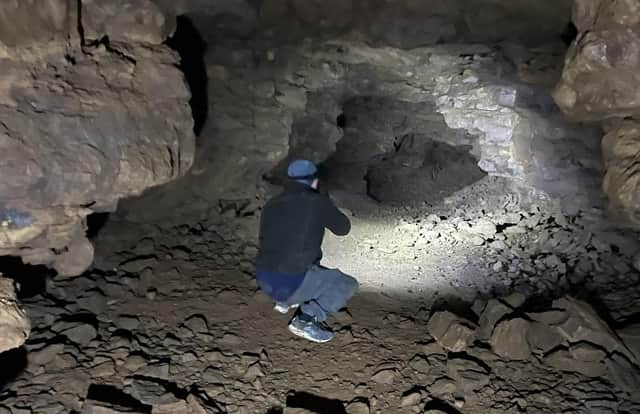
“We found some old artifacts in the tunnel. A glass bottle found was Victorian and a leather shoe sole was likely from the same era. I also found several bits of pottery and a tin pot.
“It was a fantastic experience for us all. We still have work to do, finding out what we can about this tunnel.”
Apart from physically entering tunnels, the group has conducted extensive research. In newspaper archives, including the Banbury Guardian’s past copies, they have found valuable information on discoveries of caves and tunnels in the area. A large cavern was found on Cumberford Hill in 1908 and rediscovered in 1954.
"Our most amazing discovery was recent. A tunnel was discovered at the back of the garden of a house, when a digger driver was excavating the soil to put in the concrete footings for a garage. He uncovered a hole of a good size that led into the tunnel. The hole was about four feet deep,” said Mr Green.
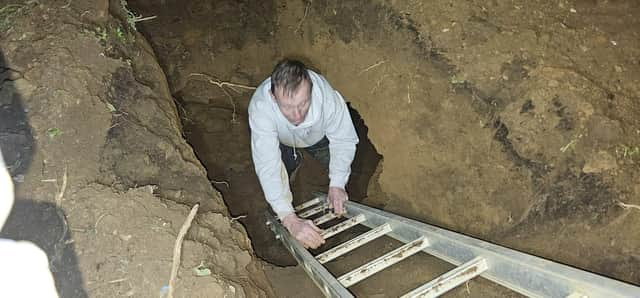
“The same evening we visited the house to see the owner and he allowed us access to the tunnel. We were really taken aback by the size and length of the tunnel and also the height in places.
“The main stretch I measured from the boundary wall was 130 feet long. Along that stretch, there were several caverns, many of which were blocked off with stone and soil.
“There were three interesting, stacked stone piles whose purpose we did not know. We wondered if anything was buried underneath them but we didn’t have time to find out.
“In the tunnel we saw lots of small bones and even some larger bones and an animal skull that we believe was from a red deer. This is very interesting because red deer antlers were found when a famous discovery was made along Tadmarton Road in Bloxham.
“A Romano-British settlement was found in 1929 and a burial site of 30 skeletons with other artifacts were discovered.
“That tunnel is definitely medieval but could it be as old as Roman? It could have been used at both times.
“The tunnels in Bloxham were used for mining stone and minerals, hiding, escape routes, religious purposes and storage.”
It is not known how far the tunnels go. The group still has many questions to find answers to.
“We have several more myths and stories about tunnels to follow up. Bloxham is steeped in history and we are on a mission to find out as much as possible about its underground tunnels.”
The Society committee hopes to put its combined talents to work in a bid to find out the answers. Mr Green has experience as a group organiser with a huge attachment to Bloxham and its people. Martin Wyatt, an author, offers administration and finance skils and Tom Smith has huge local knowledge.
To contact the group email [email protected]