
I have PTSD – my ‘natural birth’ meant swapping ambulances on the A34 hard shoulder during rush hour
A mother has described a nightmare journey in labour, strapped to a stretcher, having to swap ambulances on the A34 hard shoulder during rush hour.
Emily Portlock has described her nightmarish experience of being rushed to the JR in Oxford while in the final stage of her first baby’s birth.
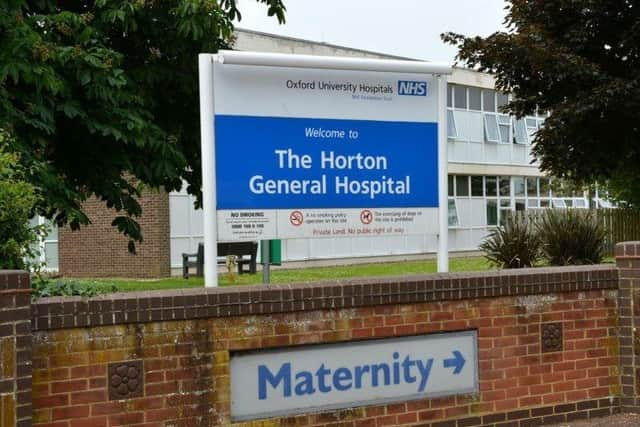
Her story is one of 40 accounts submitted by mothers who have suffered as a result of the full maternity service, with obstetric consultants and special care baby unit, being moved from the Horton General Hospital in Banbury, leaving a midwife-only unit.
The dossier of accounts has been prepared by Beth Hopper for Keep the Horton General Group (KTHG) as part of a new campaign to urge health service bosses to review the removal of obstetrics from Banbury, as the population grows alarmingly.

Emily Porter said: “After a complication-free pregnancy, I was looking forward to having as natural a birth as possible. I had accepted that if any intervention was needed, I would end up at the JR, which was my last choice,” she said.
“I remember the excitement when my waters broke and my husband phoned the Cotswold birthing suite (Chipping Norton) – and hearing that they were closed as staff were required elsewhere.
“We went to the Horton that evening to be tested whether it was waters or not. The midwife was very helpful and it was my waters. However without any contractions, we were booked into the JR for the following evening, in case.
“We were so excited and went home to ensure our bag was packed and everything sorted ready for when it might start - the nerves set in for the unknown.
"At 11pm my contractions started; we stayed at home until 4am and then drove 10 minutes to the Horton.
“My labour seemed normal and I was trying the birthing pool and using gas and air. When the contractions started making me want to push, it was very quick as I was not dilated very much.
“I was told to get out of the pool (which was not helping as it was fairly cold and didn't cover my back where the pain was) as the midwife wanted to check dilation and ensure baby was ok.
“I continued on the bed to push and remember the window getting brighter with daylight. I felt shattered.
“The midwives were discussing how the baby was not coming out. I remember my husband being told he had to go to the JR in the car as I was going to be blue-lighted there and he could not fit in the ambulance as well as the midwife.
“I'm a little blank on the rest as it's just small things that keep flashing back to me.
“There was a stent put into my hand for when I got to Oxford; I was briefly catheterised to ensure nothing was in my bladder to prevent baby moving – this was more painful than any contractions.
“I heard the ambulance crew come into the room and I was taken into the ambulance along with the midwife and her helper. It was rush hour on a Monday morning.
"I remember the journey being stop-start and uncomfortable - it was never going to be comfortable strapped to a bed in established labour anyway.
“I can recall the smell of burning rubber and assumed we had made it to JR, I had no concept of time.
“I then remember the paramedic on the phone and talking to the midwife. They were not sure where on the A34 we were, as they were from Bristol not Banbury. I recall another trying to lighten the mood, saying they had never known this to happen in 28 years of work.
"I'm afraid I wanted to stop listening and concentrate on what I was doing as it was so painful. I told the midwife I had to move or change positions as lying on my back strapped down was certainly not helping.
“Finally the back door opened and another paramedic came in and it was discussed how I was to be transferred from one ambulance to the other. I remember I had to change beds as they had to keep the correct one with the correct ambulance. This could not be done in the ambulance.
“I was wheeled out of the original ambulance and I recall opening my eyes to see tarmac on the other side of the barrier and hearing the road. They then transferred me to the second bed.
“Then I was wheeled into the new ambulance. I remember there was no gas and air available.
“This was done at the front of a huge traffic jam – the journey took two hours.
"The next thing I remember is being in the hospital and a consultant (I think) telling me the baby was too low for a Caesarean and they were going to do an episiotomy and use forceps to help baby out. I have no idea if the baby had moved and come out any further or if it was in distress.
“I was very quickly moved to theatre and there were suddenly about 15 people around me with a massive light above me. They were each informing me what they were doing. This was very professional and maybe to some people reassuring. I was completely overwhelmed by this.
“Thankfully we had a very healthy baby and I was physically fine but I have suffered with PTSD since.
“When we found out we were having a second baby a few years later, there was huge anxiety that there would be difficulties both physically and mentally. Thankfully we ended up at home and a perfectly natural birth.”
Charlotte Bird of KTHG said: “This is exactly the kind of grotesque scenario we warned about. No woman should have to suffer this anguish or pain in childbirth. We must have obstetrics returned to Banbury.”