
Banburyshire mum joins celebrity campaign against 'slippery slope' of tech in schools
A Banburyshire mother has joined actor Hugh Grant and other celebrities in urging parents to respond to consultation on future use of screens in the classroom and exams.
Mother of one Mary Sutherland, who lives in a village near Banbury, is one of many parents who have joined campaigns opposing increasing screen use in education.


She believes parents have been not been given sufficient information about the dangers which are only now being discovered through research. And she urges families to respond to Ofqual’s consultation on proposals for how on-screen assessment in GCSEs, AS and A levels in England. It proposes a ‘controlled introduction of on-screen assessment, with pen-and-paper remaining central to most exams’.
The campaign group Close Screens, Open Minds – headed by actor Hugh Grant, actress Sophie Winkleman and psychologist and author Jonathan Haidt – says: “This technology was to revolutionise our children’s education. It didn’t happen. Instead, we’ve watched comprehension plummet, attention collapse, physical and mental health decline and tech companies harvest our children’s data.
"The evidence is overwhelming and countries that led the digital revolution are bringing back books. EdTech is a profiteering solution to a problem that was never there. Children deserve real learning, not more screen time."
Mrs Sutherland and thousands of others believe screen exams will steepen the ‘slippery slope’ of increased computer use in schools.
“I hope other parents will join me in trying to hold back the tide of ‘edTech’ facing our children,” she said.
"It will be more difficult to reverse once it goes too far and I see this invitation to voice my concerns to Ofqual as an important opportunity to contribute to this pivotal debate. We don’t have much time; the consultation ends tomorrow (March 5).
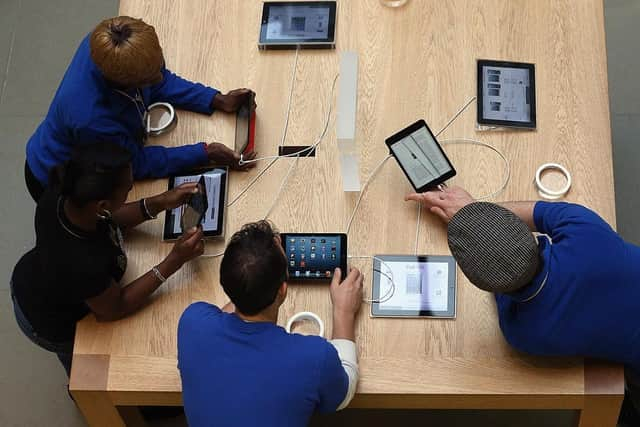
Mrs Sutherland says most people instinctively realise the harm screens can have on people.
"The catastrophic consequences of a screen-based childhood have been studied and documented. We are only just beginning to understand how far-reaching the harms are on children’s developing minds, emotions and bodies, from poor eyesight and bad backs to poor sleep and anxiety. Many of the harms are irreversible because they come at the peak of development.
“It has also been realised that screen use is directly linked to a decline in cognitive ability and academic achievement. Use of screens has a detrimental effect on the ability of children – and adults - to concentrate.
“What do we want our children to gain from their education if not to build cognitive skills and their capacity for concentration? Those are the tools that will enable them to solve life’s problems.
"How can we accept the attempts of our education system to actively increase use of an agent which is proven to be the enemy of both, as well as damaging, not bolstering, their physical wellbeing and emotional resilience?”
Campaigners against edTech in schools compare screens to junk food or cigarettes.
"If I don’t give my daughter a phone or tablet, don’t feed her sugary drinks and highly-processed food because they are bad for her - I don’t expect school to counter that by ‘feeding her’ precisely what I try to keep her away from. Not just because it’s my own whim but because it is proven.”
Campaigners believe schools should be run in the best interests of children. They disagree with undue concentration on producing ‘techie’ children for future business. Instead they want schools to foster ‘the physical, emotional and academic best in each child’.
“Ofqual’s description of the proposals are all about innovation but give no mention of the positive outcomes for the physical, mental and emotional health of students. They talk instead about ‘potential benefits to technology’, ‘curriculum delivery’, greater ease of marking and efficiencies. These are not centred on pupils but the benefits to the system,” said Mrs Sutherland.
"I want my daughter to be prepared for a full, enriched and meaningful life, not purely for a job in tech. If her eyesight, body and brain and emotional resilience have been stunted by screen use, she will have been failed by me and the education system.
"It seems a safer bet for her to be prepared for a job outside tech because it’s less likely to have been replaced by AI.”
She said: “We need to halt this trend before we lose teacher skills, who will soon be trained as technicians to hand out tablets. We need to act now for the good of our children who haven’t asked to be part of a social engineering program.
“The social media ban being debated will be useful for parents fighting against their children being damaged by screens. But social media isn’t the only harmful aspect of a smartphone. Some edTech elements replicate the harm of social media, like addictive ‘quick dopamine’, short-form video and the messaging distraction, not to mention possible harmful and disturbing content,” she said.
“Screens are addictive and actually wire children’s developing brains towards other addictions.
“This is a problem more easily tackled through collective action and it will be down to parents to put pressure on the schools, MPs and education bodies to listen to what - less screen time, not more,” she said.
Safe Screens, which campaigns to protect children from the harms of unregulated EdTech and addictive-by-design smartphones has launched a petition.
“We are calling on Government to pause the use of devices and EdTech in schools until such time as net educational benefit can be demonstrated, and independent studies can confirm that 1:1 device use does not pose unacceptable safety an wellbeing risks for school-age children,” it said.
The Ofqual consultation survey is here.