
The International Women’s Day celebration was a powerful show of solidarity with women worldwide — and a testament to their relentless hard work to make Banbury a better place to live.
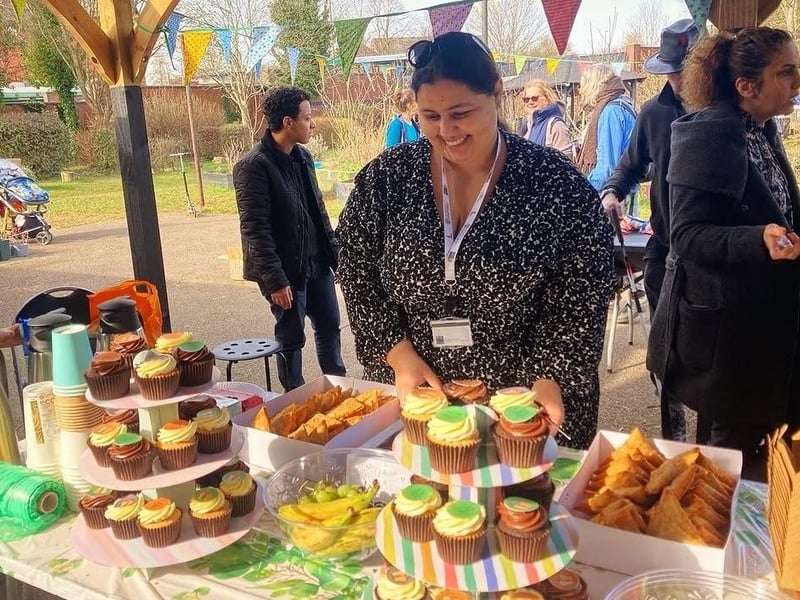
“Today, I want women to stand up and boast about their achievements,” said Tila, swiftly arranging tea urns, paper cups and snacks on a foldout table in Bridge Street Community Garden. As is often the case when I speak to Tila, she was surrounded by a busy throng of volunteers.
“Girls are told from a young age to be humble," Tila continued. "But if you look at all the community stuff happening in Banbury: so much is arranged by women and we rarely get the credit. We’re going to change that today.” As the beneficiary of a project Tila runs, I couldn’t agree more.
Visitors trickled in as members of Multaka Oxford, a project that brings together refugees, migrants and local communities, finalised the table preparations. Ash Hamoud, who organised the event with Tila, told me they wanted to create a warm space that celebrates women and honour their achievements.
International Women’s Day has roots in radical activism. First proposed by German Socialist Clara Zetkin in 1910, it was intended to press for demands like women’s suffrage, labour rights and free childcare. While its message has become diluted in recent years, it felt good to be spending the day alongside women working to reshape their communities.
The programme kicked off with writer and singer Patrissia Cuberos speaking about the perspectives of immigrant women in her latest book, before creating circles for a singing exercise. As harmonies rose and fell, Patrissia referenced the genocide in Gaza as a result of contrasting voices not finding space for one another.
The crowd were then treated to an assortment of cupcakes by @ fluffy bakes and 50 fresh samosas, prepared by local women who preferred not to be named. This reminded me of something Tila had said earlier: women are often quiet organisers behind community events like this — preparing food, setting up spaces — yet their work often gets taken for granted. “It’s as if all the food just magically appears,” she’d joked.
While light-hearted, her comment speaks to a wider problem: capitalism’s erasure of women’s unpaid labour. As Kate Raworth points out in Doughnut Economics, Adam Smith's seminal economic text overlooks his mother, Margaret Douglas, who cared for him well into adulthood while he wrote The Wealth of Nations. Her contributions never made it into his theory, and this omission perpetuated the invisibility of such labour for centuries.
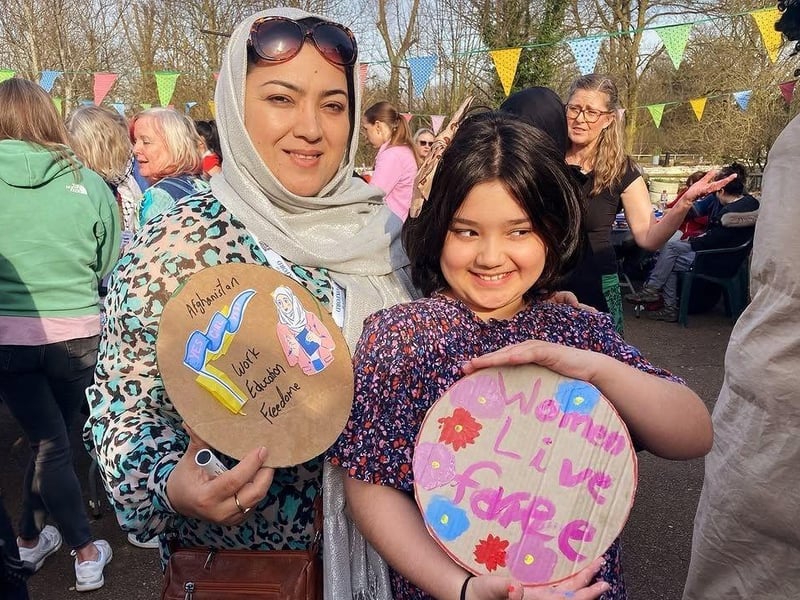
Next came a series of speeches. Tila and Ash passed around a ‘talking stick,’ giving each woman five minutes to share their perspectives. Batool Haidari, professor of sexology at Kabul University who taught mixed-gender classes and supported patients with gender identity issues, was forced to flee her post when the Taliban took power in 2021. She spoke briefly but passionately about the fight for women’s education: “We must support women everywhere; let’s fight for women in Afghanistan, Iran and Syria!”
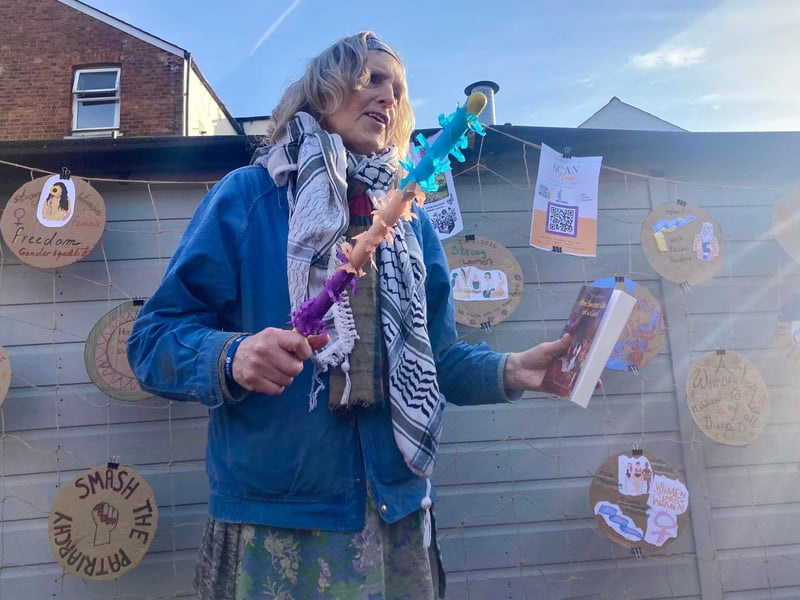
Rachel Payne, transwoman and 'nonviolent Earth defender', is awaiting trial for scaling an M25 gantry during COP27, after which she was misgendered and held in solitary confinement in a men’s prison. After recounting this harrowing experience, she described the motivation for her protest: “I fear so much for the liveable futures of my five beautiful grandchildren.”
These stories highlight how the crises of our time — from climate breakdown to the genocide in Gaza - disproportionately affect women and girls, and how a multitude of women with diverse backgrounds, stories and identities are leading the charge to challenge them.
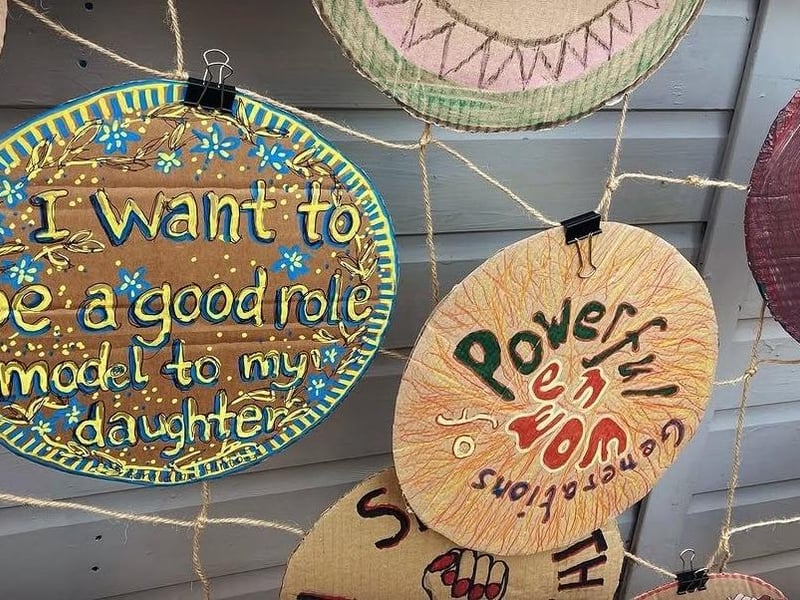
After the speeches, Multaka Oxford directed attendees to decorate cardboard cut-outs with messages of solidarity for women around the world. These were strung together on biodegradable green netting, which would later be hung in the window display of Nothing But Footprints in Castle Quay.
Amid the creative chaos I got chatting to Taraji Ogunnubi, who moved to the UK from Nigeria at 13. While working for the charity Sofea, she learned Banbury is the second most food-deprived place in Oxfordshire, and in response founded Banbury Larder — a membership-based food hub which works to cut supermarket waste, provide access to healthy food and offer employment support.
“For me, it was about setting an example for my daughters,” Taraji explained as children darted between the garden’s hexagonal planters. “In Nigerian culture, women are caregivers and role models who transform society from a place of love.”
Hira Faisal, an artist from Pakistan who won the Banbury Waterways Art Competition in 2024, has run art therapy sessions at Bridge Street. In Pakistan, she explained, women are often seen as objects of beauty, whose greatest achievement is securing a grand wedding. Her art — including a portrait of a woman with a butterfly covering her mouth — confronts these narratives. During her art therapy sessions, Hira has seen women from all backgrounds find creative release from social pressures.
“It was moving to realise that women here felt the same pressures I’d seen in Pakistan,” she told me. “Art gives women everywhere space to express themselves creatively and emotionally.”
As the event wound down, I reflected on the situation faced by women worldwide in 2025. Despite the strides made by activists for women worldwide, there is still much work to do. With the climate crisis intensifying and abusers in power cheered on by an emboldened online ‘manosphere’, the need for action has never been greater.
While one day a year is never enough to solve the challenges women face, the celebration came at a crucial time: offering a powerful reminder of the strength and resilience of the women driving change in our community.
1. International Women’s Day at Bridge Street
Ash Hamoud from Multaka Oxford wanted to celebrate women and honour their achievements Photo: @bridge_street_community_garden
2. International Women’s Day at Bridge Street
Batool Haidari was a professor of sexology at Kabul University before The Taliban forced her to flee in 2021 Photo: @bridge_street_community_garden
3. International Women’s Day at Bridge Street
Participants created messages of solidarity to women worldwide on cardboard circles Photo: @bridge_street_community_garden
4. International Women’s Day at Bridge Street
'Nonviolent Earth defender' Rachel Payne is awaiting trial forprotesting climate breakdown during COP27 Photo: @bridge_street_community_garden